[ Lab ]
The Shoot That Never Happened.
Publish date
2 December 2026
Written by
Sorbet World
Before The Image
None of these photographs were taken.
There was no studio booking. No call sheet. No wardrobe rack. No photographer waiting for the light to cooperate.
And yet the work still needed casting, styling, composition, lighting, camera language, pacing, and a point of view.
That is the part of AI photography we find most interesting.
The camera may not be there.
The direction still has to be.
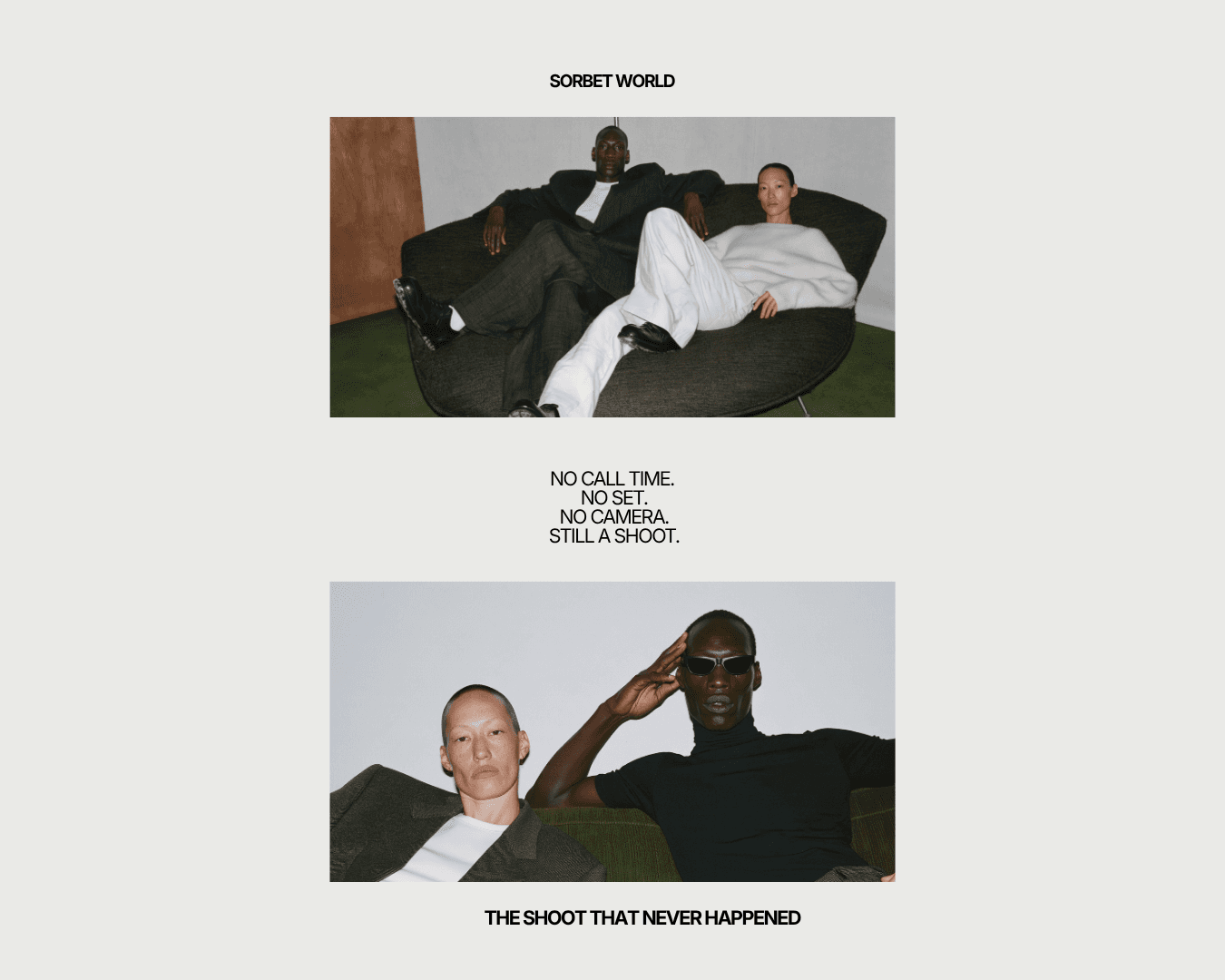
Photography Without The Production Day
AI changes the mechanics of making an image, but it does not remove the decisions that make an image feel intentional.
Who is in the frame?
What are they wearing?
How close is the camera?
Does the flash feel harsh or accidental?
Should the image feel expensive, awkward, intimate, detached?
Those choices still shape the final photograph.
The production day disappears.
The creative decisions do not.
Real Enough Is Not The Goal

Photorealism matters, but realism alone is not very interesting.
A technically convincing image can still feel empty.
For Sorbet, the goal is not simply to make people ask whether the photograph is real.
It is to make the image feel like it belongs to a larger visual language.
A particular crop.
A recurring casting attitude.
A certain kind of flash.
A world with enough consistency that one image naturally leads to the next.
The illusion is only useful if there is an idea underneath it.
The Shoot Still Has To Be Directed
The strange thing about AI photography is that a shoot can now happen without anyone physically stepping onto a set.
But the responsibilities of creative direction remain.
You still need to decide what belongs.
You still need to reject the almost-right image.
You still need to notice when the model stops looking like themselves, when the clothing changes, when the light breaks the world, or when everything becomes a little too perfect.
The shoot may never have happened.
The campaign still had to be made.


