[ Culture ]
Step Inside Sorbet World
Publish date
18 October 2026
Written by
Sorbet World
Step Inside
Before Sorbet World became a creative studio, it was a place for experimentation.
We created AI imagery around Black and queer identity, fashion, beauty, color, fantasy, and the kinds of people I wanted to see occupying these new visual spaces.
There was no perfect business plan behind it.
A lot of the work started with curiosity.
Those experiments eventually caught the attention of WOW World, which featured Sorbet World in “Step Inside Sorbet”
Seeing the work move from my screen into a magazine changed the way I understood what I had been building.
It was no longer just experimentation.
There was a point of view forming.

Color Was Never Just Decoration
A lot of the early Sorbet work was loud.
Color everywhere.
Unexpected environments. Fashion that did not ask permission to behave. Black and queer subjects placed inside worlds that could be playful, surreal, glamorous, strange, intimate, or completely invented.
Color became one of the ways I could give those worlds their own temperature.
It could make an image feel joyful without becoming innocent.
It could make something futuristic without turning everything silver.
It could make Black skin the center of a palette instead of something the palette had to accommodate afterward.
That mattered to me.
So much visual work around the future has historically been imagined through a very narrow vocabulary.
Chrome.
White rooms.
Black glass.
Blue light.
Technology presented as cold, perfect, and somehow culturally empty.
I was interested in a different future.
One with red.
Yellow.
Pink.
Green.
Brown skin.
Big hair.
Strange clothes.
Personality.
A future that actually looked like people lived there.
AI Gave The Experiments Somewhere To Go
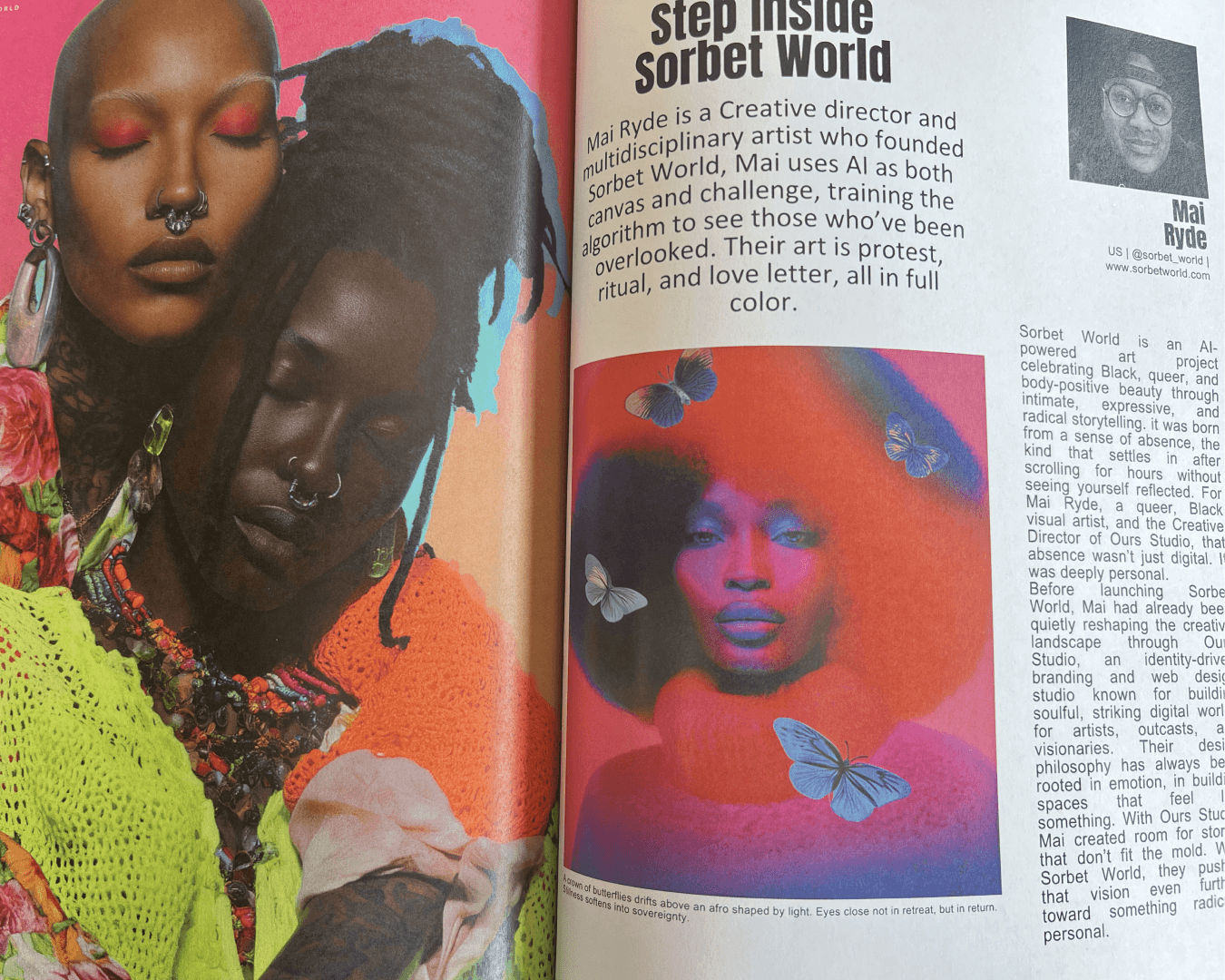
AI was a major part of how that work came together.
At the time, I was interested in what happened when these tools were pushed toward subjects and aesthetics I was not seeing enough of elsewhere.
The technology made experimentation fast.
A character could move from a beauty portrait into a completely different environment. Fashion could become impossible. Color could be exaggerated. An idea that existed only as a loose image in my head could suddenly become something I could respond to.
But generating the image was never the entire process.
There were still decisions around casting, styling, composition, color, expression, editing, and which images actually felt like Sorbet.
A lot of technically good images did not make it.
Some were beautiful and completely wrong.
That editing process is where I started recognizing something that now sits at the center of Sorbet World.
The tool can give you possibilities.
Direction is what turns those possibilities into a body of work.
The Feature Was A Beginning, Not An Ending
Seeing Sorbet inside WOW World felt significant because someone outside of my own process had recognized something in the work.
But the version of Sorbet featured in the magazine was still changing.
Since then, the practice has expanded from AI art into creative strategy, creative direction, campaign development, image production, film, motion, sound, and complete visual worlds.
The scale changed.
The thinking underneath it did not.
I am still interested in color.
Still interested in Black and queer people existing inside visual culture without needing to explain why they are there.
Still interested in fashion, music, beauty, nightlife, strange references, and images with enough personality to feel like someone actually made a decision.
And I am still interested in what happens when new technology is directed through perspectives that have historically had less control over how the future gets pictured.
Step Inside Sorbet captured an earlier version of that idea.
Looking back now, it feels less like a feature about where Sorbet had arrived.
It feels like documentation of where the studio was beginning to go.


